

Posts from — November 2009
Suntory Midorie Design Contest | Results

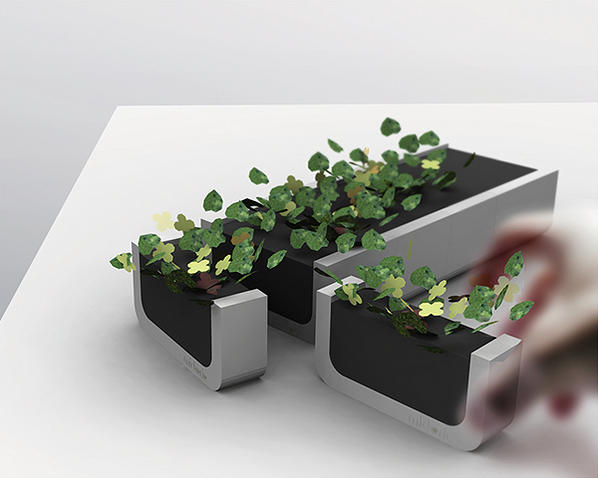
Last night Suntory’s subsidiary Midorie announced the winner of their first-ever Midorie Design Contest. Midorie launched its services in 2008 and offers rooftop and wall surface greening that utilizes Puffcal, “an originally developed sponge-like soil substitute” that is lighter and more versatile than soil. The guidelines of the contest were to use Puffcal in an innovative fashion to create green-design.

The winners were the members of the design studio kenma, who proposed OSUSOWAKE (which means sharing, in Japanese) a planting system that could be grown and then divided in order to distribute to friends and family. Recipients can then combine them with any existing Puffcal plants that they may have, creating a unique plant that becomes symbolic of the ties and connections you have with others. The proposal completely rethinks the notion of plants and goes beyond the possibilities that conventional potting soil offered which, in the end, won them the award.

Here is the official press release (Japanese PDF) where you can see some of the runner ups, which include planters that can be stored in bookshelves and planters that act as umbrella stands, feeding off the dripping rainwater.
Related:
November 30, 2009 8 Comments
Balloon as vase by Shun Kawakami
I hope everyone in the US had a Happy Thanksgiving and everyone everywhere else had a Happy Thursday! I was saving this post because it seemed festive and I kept thinking how awesome it would be to welcome guests into a home adorned with flower vases like these.
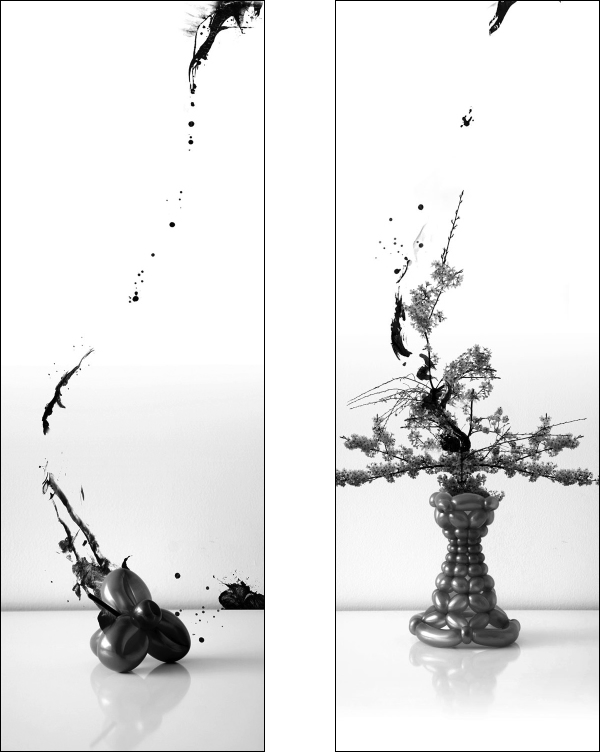
So, last month art director Shun Kawakami embarked on a bold collaborative project, balloon as vase, to create these fascinating vases that you might see if Jeff Koons hosted a Zen tea ceremony.
I actually considered cropping the vases to optimize them for viewing but decided to preserve the originals because they are really so beautiful in their long and narrow orientation, reminiscent of Chinese scrolls. So please click to enlarge!


Photos by Yuu Kawakami | click to enlarge
The vases were originally created for “composition of knowledge and feeling,” an exhibition by Shun Kawakami and Takashi Kawada that was shown at JAGDA TOKYO last month. Other collaborators include balloon artist Rie Hosokai aka Daisy Balloon and calligraphy artist Gen Miyamura, both artists in their own right, and whose standalone work I have shown below.

Flame (2008) by calligraphy artist Gen Miyamura, who creates works in highly deconstructed forms of calligraphy. One may even go as far as calling it abstract. In the past Miyamura has done CD jacket designs, movie posters, and even commercial work for Bridgestone and Docomo.

A dress by balloon artist Rie Hosokai, who started balloon art in 2002 and went on to reign supreme in almost every balloon folding exhibition she entered. The icing on the cake was her 2 consecutive wins in Millenium Jam with her haute couture dresses made from balloons.
Related:
November 27, 2009 5 Comments
Japan Brand: The Wish List | Felissimo Design House

On Monday I went to go check out the opening reception of JAPAN BRAND: The Wish List pop-up shop at Felissimo’s headquarters in midtown Manhattan. The show runs through December 24th and is a must-see for anyone scouring the market for unique gifts. The impressive lineup is suitable for all budgets, and I mean all. Prices start in the single digits for exquisite washi-paper mailing cards and go as high as $18,000 for an amazing bicycle designed by Alexander Gelman and hand-lacquered by the Yamanaka Urushi masters of Ishikawa Prefecture.
Japan Brand: The Wish List
Felissimo Design House
10 West 56th St, New York
Only until December 24
Monday-Saturday, 11am-6pm


One of the highlights for me was seeing some pieces from the Nippon Sense collection, a masterfully designed series of furniture that was a collaborative effort between the Japanese and Italians.

Alexander Gelman‘s urushi bicycle

Monacca bags hand-crafted from environmentally sustainable Yanase cedar sheets harvested in Kochi Prefecture.

An awesome selection of knives for any respectable epicurean.
Also, be sure to check their website for upcoming events through the end of this month and into December that include tempting hands-on sake tasting, a cooking demo from Nobu chef Akiko Thurnauer and much more.
November 25, 2009 8 Comments
Japan’s Hit Products of 2009
Speaking of forward-looking, Nikkei Trendy just released their backwards-looking top 30 products of 2009. The selection is based on 4 major categories, sales, ingenuity, market-creation and influence, and is a good barometer for some of the major trends seen in Japan throughout the year. Here is a lineup of the top 10, accompanied by graphics and original Spoon & Tamago commentary.

1. Prius & Insight
Honda announced the release of Insight during February of 2009. In a matter of days they booked orders that were 3.6 times their initial monthly sales estimates. A bit late to the game, Toyota announced the release of their 3rd model Prius in May of 2009. Following the announcement they booked 80,000 orders and went on to book 180,000 orders after the car went on sale. However, the rush to buy was most likely, in part, due to government incentives to purchase eco-products.

2. Kirin Free
In April of 2009 Kirin released the “first ever” 0.00% alcohol beer, Kirin Free. Calorie-conscious consumers, as well as party-goers fearful of recent crackdowns on drunk-driving, ran to the supermarket to get their hands on this new beverage. Just after 1-month on shelves the company reported that they had already breached their 6-month sales target.

3. Dragon Quest IX: Defenders of the Starry Sky
Released on July 11, 2009 (originally 3/28 but was pushed back), the 9th installment of Square Enix’s popular Dragon Quest series has already sold over 4 million copies (as reported by the company). And yes, it was only released in Japan. According to this list of all-time best selling games, it has already secured a spot around 13th and will likely continue to inch its way upwards.

image courtesy of e-mask.jp
4. Anti-influenza products
The H1N1 scare has obviously resulted in tremendous sales of hand-sanitizer and masks. Japan’s first confirmed case was in May. I remember this well because I had to fly to Japan and we were grounded at Narita for over an hour while people in biohazard suits came on the plane to scan people for higher-than-normal body temperature. It wasn’t rare to see drugstores advertising new shipments of masks as supplies were being depleted all over the country.

5. Ashura: A National Treasure
The Tokyo National Museum in Ueno must have been surprised when swarms of teenagers showed up at the “Ashura: A National Treasure” exhibition. I mean, who ever heard of a 90-minute wait to see a statue of some old Buddhist deity? Helped in part by an aggressive marketing campaign (I remember seeing posters all over the train), Ashura struck a cord with 20-something females and was catapulted into ikemen status, short for Iketeru Men and defined by urban dictionary as a “damn good looking guy.”

6. Kokuyo dotted notebook
Leave it to the Japanese to improve on – revolutionize – and age-old staple such as the notebook. In their recent iteration, Kokuyo has added evenly-spaced dots along the lines to create their dotted notebook. This subtle yet ingenious change enables drool-worthy beautiful note-taking that is sure to get you into Tokyo University, or so they say. The funny thing is, Kokuyo actually initiated a study to analyze the notebooks of Tokyo University Students and the result was this dotted notebook.

7. uno fog bar
Shiseido came up with Uno, a line of mens beauty products, in 1992, and released Fog Bar, their latest hair gel, during mid-August. Except it’s not a gel. It’s a foggy mist that made quite a storm of commotion. The equation though is quite simple. Develop a new concept, throw in words like Polyacrylate Cross Polymer to make it sound like a ton of scientific research went into the development, hire 4 en vogue male actors to promote it and you sell over 2 million in the first 2 weeks (as reported by the company). The one surprise turned out to be that the majority of consumers were female, rather than male.

8. Pomera
The Pomera is a portable memo pad manufactured by King Jim, the number one maker of filing cabinets. The Pomera was released in late 2008 and was an immediate hit with cash-strapped consumers still looking to satisfy their taste for new electronics (Amazon Japan had it listed for just over $150). Their newest model, the DM20, is slated for release on December 11th and will be equipped with a cool feature that allows you to convert your composed document into a cellphone-readable QR Code.

9. The Steam-less Rice Cooker
Kids being burnt by steam emitted from rice cookers, or at least the perception of it, was so common that Mitsubishi Electric went and developed a steam-less rice cooker. I’m not sure how you cook rice without the byproduct of steam but Japanese engineering has made it possible. The product took home a Kids Design Award and a Good Design Award this year for its functionality and sleek design.

image courtesy of sankei news
10. 990 yen jeans
I think it’s pretty well known that Japan’s economic woes have resulted in a migration pattern from high-end to low-end. And UNIQLO, king of affordable basics, was in a prime position to benefit. In March of 2009 their subsidiary g.u. shattered all preconceived notions about denim by announcing that they would be selling 990 yen jeans. Just 1 month after being release the company doubled their sales estimates to 1 million pair.
November 25, 2009 1 Comment
2018 | 2022 World Cup Bid
Although I’m still not ready to let go of 2009 the JFA (Japan Football Association) is looking ahead; far, far ahead. They recently launched Japan’s bid to host the 2018 and 2022 Football (better known as soccer here in the States) World Cup with some very attractive graphics designed by Yuji Tokuda.

Related:
- I LOHAS by Yuji Tokuda
- Yuji Tokuda for Suntory
- Yuji Tokuda | Art Director
- Retired Weapons by Yuji Tokuda
November 24, 2009 2 Comments
The Selby | Yasumasa Yonehara
Wow! It’s great to see iconic Japanese photographer Yasumasa Yonehara’s home featured on The Selby (which is now offered in Japanese, by the way). Cluttered chic with a touch of erotica. That is exactly how I imagined his home would be. There’s a great (and long) interview over on Mekas if you would like to learn more about Yonehara and the explosive influence he has had on kogyaru culture and the teenage-media industry as a whole.
November 20, 2009 4 Comments
Sachie Muramatsu

Speaking of Baden-Baden, I spotted a new piece of work by lighting designer Sachie Muramatsu who has been working with washi paper for over 10 years making exquisite plant and foliage-inspired lamps. Her latest seasonally appropriate pendant lamp (above) goes for 8,400 yen. But be sure to check out some of her older work too! My favorite is the Hozuki Lamp, inspired by the Hozuki, or the Chinese Lantern Plant.

Hozuki Lamp

Hanamizuki Lamp

Ajisai Lamp
November 20, 2009 6 Comments
Fall is in the air
Fall is in the air! I can smell it in the fallen leaves, hear it in the flocks of migrating geese, and see it in the scarves and hats. Fall is one of the most popular seasons in Japan and to accompany it are several phrases such as the season of harvest (minori no aki) the season of sports (sports no aki) the season of hearty appetites (shokuyoku no aki) and the season of reading (dokusho no aki). Japanese design shop Baden-Baden has recently introduced their new items for the month of November and they are all about books and reading! I especially love the cutlery bookmarks (reminds me of thanksgiving) and the book necklaces!


From top to bottom:
Cutlery bookmarks by 2e (1,512 yen)
Butterfly bookmarks by D-Bros (683 yen)
Book necklaces by Naho Yamamoto (5,040 yen)
Plywood Book stand by Flange aka Ueda Tsuyoshi (4,725 yen)
Tree Bookcover by Naruse (3,150 yen)
Related:
November 20, 2009 3 Comments
I Remember You | Atelier Norisada Maeda
Last month Atelier Norisada Maeda dotted the I’s – if there were any – on their vectors and equations for I Remember You, a home in Tokyo whose form was left up to an algorithmic analysis that comes from processing memories into sunlight. I don’t quite understand the process but the architects, in collaboration with 2 NY-based programmers, developed an algorithm that somehow translates the memories of past residents, namely a deceased brother, and images, namely a deceased pet rabbit, into screens of light. These screens were then incorporated into the design of the home, hence the name “I Remember You.”
This is actually a very intriguing project that succeeds in a quite literal fusion of memory and tangible landscape. What a beautiful method of embedding and preserving memory in one’s own dwelling.
November 17, 2009 Comments Off
Toyo Kitchen spices things up, or a short history of Spanish design in Japan
Earlier this year Toyo Kitchen announced the release of Barcelona Design, a line of eccentric work by flamboyant Spanish designers such as Jaime Hayon and Antoine+Manuel. And despite the hefty price tags the company has been expanding their product mix to include tables, chairs, mirrors and even vases. Although the mix includes no original furniture – rather a reproduction of some of the designers’ more notable pieces – Japanese consumers, for the first time, are able to purchase these one-of-a-kinds from their nearby Toyo Kitchen showroom which, by the way, happens to be the largest kitchen showroom in all of Japan.

Tout va bien by Antoine+Manuel (990,000 yen)
And while it’s hard to imagine any of these pieces in a minimal, subdued Japanese home, Jaime Hayon is not exactly a stranger in Japan. Hayon’s renown in Japan was sealed when he began designing – interiors and shoes – for Camper Shoes, which had developed an almost instantaneous cult following upon their Asian invasion in 1996.

Multi-leg Cabinet by Jaime Hayon (728,000 – 990,000 yen)
Taking notice of Japan’s affinity for Spain’s brash attention to detail and design aesthetic, the Spanish Embassy in Japan hosted an exhibition in 2007 in conjunction with 100% Design Tokyo. “Spain Playtime – Fresh Air in Spanish Design” was curated by Ana Mir and Emili Padrós from Emiliana Design Studio and featured many of Hayon’s designs. (The show was repeated in 2008 with Jaime Hayon again leading the pack of designers.) “Spain Playtime” met with great acclaim and was featured in several high-profile magazines. At that time Hayon had already begun his collaborative efforts with Camper but two years later, during the summer of 2009, Christmas arrived early in Tokyo with an Hayon-designed Camper store in Omotesando.

Armchair outdoor by Jaime Hayon (78,000 yen)
Anyway, my final thought on the topic is, designer shoes are one things but I find It very hard to imagine that the people buying camper shoes are the same people buying kitchen tables and cabinets.

Armchair + cover by Jaime Hayon (1,100,000 yen)
Related:
November 17, 2009 5 Comments