Japanese Designers 101
I`ve found that while Japan has always been a significant force in the world of design, not many people are familiar with the names or faces behind the distinct aesthetic. In this edition I would like to briefly introduce some of the notable industrial designers of the 20th Century that have made meaningful contributions to what we know today as Contemporary Japanese Design.

1905 – Kappei (Katsuhei) Toyoguchi
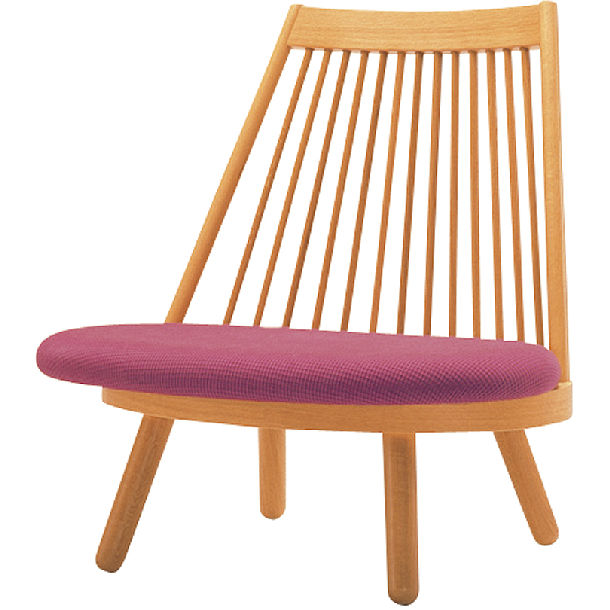
Recognized as one of Japan`s pioneers of modern design. Much of the foundational data derived from research conducted by Toyoguchi and his staff involving furniture design was later adopted and incorporated into the JIS (Japan Industrial Standards).

(Spoke Chair)
———-

1911 – Watanabe Riki
Riki was involved in the establishment of many of Japan`s groundbreaking organizations, from the Japan Design Committee to the Japan Industrial Design Association. He was also responsible for the interiors of many famous buildings including the Tokyo Hilton (currently Capital Tokyo), Keio Plaza Hotel and Prince Hotel. One of his greatest skills was creating beautiful furniture using cheap, affordable materials as resources were scarce after World War II.


(Himo-Isu, Solid Stool)
———-

1912 – Isamu Kenmochi
Isamu Kenmochi is widely recognized as one of the pioneers of Japan`s design industry. In 1990, production of his “Stacking Stool” surpassed 1 million units. The stool embodies simplicity, beauty and functionality, all which represent the style of Kenmochi. In 1964 his “Lounge Chair” was recommended by Marcel Breuer and admitted into Moma`s permanent collection.


(Bamboo Basket Chair, Kashiwado Chair)
———-

1915 – Sori Yanagi (aka Munemichi Yanagi)
After winning both 1st and 2nd place in the first Japan Industrial Design Contest in 1952 Sori Yanagi established his own design studio. In 1957 he was invited to participate in the 11th Milan Triennial where his “Butterfly Stool” won the golden prize. In 1980 he became the first designer to hold an exhibition at the prestigious Galleria d’Arte Moderna in Milan, Italy. Yanagi helped open doors as an international artist and paved the way for future designers to display their work abroad.


(Butterfly Stool, Elephant Stool)
———-

1921 – Daisaku Cho
After graduating from the Tokyo National University of Fine Arts & Music, and undertaking various architectural and design assignments, Daisaku Cho’s work was recognized at the 12th Milan Trienial (1960) where “Persimmon Chair” helped the Japan booth win the gold prize. In 1972 he established his own architecture office. His recent work has a great emphasis on “re-design,” as the artist has gone back over his previous portfolio of work and improved on several pieces.


(Dining Chair, Persimmon Chair, Teiza-Isu)
———-

1937 - Masayuki Kurokawa
Masayuki Kurokawa currently runs his own architectural firm, Masayuki Kurokawa Architect & Associates, Inc. His contributions to contemporary design have been profound. Perhaps his most notable work is the “GOM Series” (housed in MoMa’s permanent collection) in which rubber was used as the primary material in a most aesthetically pleasing fashion.


(Between, Kaze, Next Maruni)
———-

1938 – Makio Hasuike
After graduating from art school, Makio Hasuike began designing clocks for Seiko. An invitation led him to Italy where in 1968 he founded his own design studio. The artist has always been ergonomically conscious, and designs much of his work after lengthy observations of human behavior. Hasuike currently teaches at Politecnico di Milano and helped found the Master’s Degree in Strategic Design.


(GEDY, Impronta, Toilet Brush)
———-

1940 – Motomi Kawakami
After obtaining his MFA from the Tokyo National University of Fine Arts and Music, Motomi Kawakami began working for Angelo Mangiarotti in Milan, Italy. In 1971 he established his own design studio and has been producing work from there ever since. His most accomplished areas are those in crafts, product design, and space/environmental design.


(Blitz Folding Chair, Sopra-Fiume)
———-

1941 – Masanori Umeda
Masanori Umeda’s skills were honed under many years of studying under one of Italy’s great master’s, Achille Castiglioni. He went on to work for Olivetti after accepting an invitation from one of the directors of design at the time, Ettore Sottsass.


(Robot Cabinet, Rose Chair)
———-

1942 – Toshiyuki Kita
Toshiyuki Kita works in both Japan and Italy, but his creations are distinctly Japanese. This is because the artist utilizes materials and techniques that are deeply rooted in Japanese culture. The Wink Armchair (1980) and the Kick Table (1984), designed for Cassina, are housed in MoMA’s permanent collection.


(Wink Armchair, Kick Table)
———-

1942 – Isao Hosoe
Born in Tokyo in 1942, Isap Hosoe received his Bachelor of Science (1965) and Master of Science (1967) in Aerospace Engineering from the Nihon University of Tokyo. His thesis project, “The Man Powered Aircraft,” is an example of the influence he has had on art and design. He is probably most well-known for pioneering the idea that scientific research comes before good design, and that artistic solutions are a result of innovative thinking and new knowledge. He collaborated with Alberto Rosselli of the Studio Ponti-Fornaroli-Rosselli from 1967 to 1974. He has been professor of Industrial Design at the Politecnico of Milan and at the Università degli Studi, La Sapienza of Rome.


(Hebi Lamp, Tacit)
———-

1943 – Shigeru Uchida
After graduating from Kuwasawa Design School in Tokyo in 1966, Uchida wasted no time in establishing Uchida Design Studio merely 4 years later. In 1981 Uchida took part in a joint-collaboration to establish “studio 80” with Ikuyo Mitsuhashi and Toru Nishioka. Uchida has worked on a wide range of projects from interior design and furniture to products and urban planning, in japan and abroad. His major works include the wave building in Roppongi, a series of Yohji Yamamoto’s boutiques, the Japanese government pavilion at the expo ‘85 in Tsukuba, the lobby of the Kyoto hotel, and the Kobe fashion museum.


(Moonglow, Uchida Residence, Rattan Chair)
———-

1949 – Kazuo Kawasaki
Kazuo Kawasaki studied 3D-CAD/CAM and media integration product design in school. An accident early in his career caused him to become paralyzed from the waist down, and gave him permanent heart trouble. However, the incident motivated him to focus his efforts on merging product design with medical science. His work was recognized when he was awarded a PhD for his accomplishments in space theory. Also known as an old-school Mac-user, he had a contract with Apple in the early 1990s to work on a portable machine project. He is currently working on a project known as “Peace-Keeping Design (PKD).”


(Carna Folding Wheelchair, MP-901 Glasses, Epita)
———-